New InfluenceMap analysis shows how the aviation industry reinforced a long-standing lobbying pattern against the expansion of the EU Emissions Trading System (ETS) to all flights departing the European Economic Area (EEA) in the run up to the policy review in 2025. Support for the policy among low-cost carriers declined, while legacy airlines and industry associations continued their long-standing efforts to block the expansion of the geographical scope of the policy.
Accelerating opposition to a full scope EU ETS comes amid growing aviation industry advocacy to weaken other binding climate regulations in Europe, threatening the rapid emissions reductions essential to meeting the EU's climate goals. This change in advocacy, alongside the failure to strengthen the Carbon Offsetting and Reduction Scheme for International Aviation (CORSIA) at the International Civil Aviation Organization’s 42nd Assembly in October 2025, calls into question the credibility of industry-led technological solutions and voluntary measures to address the sector’s climate impact.
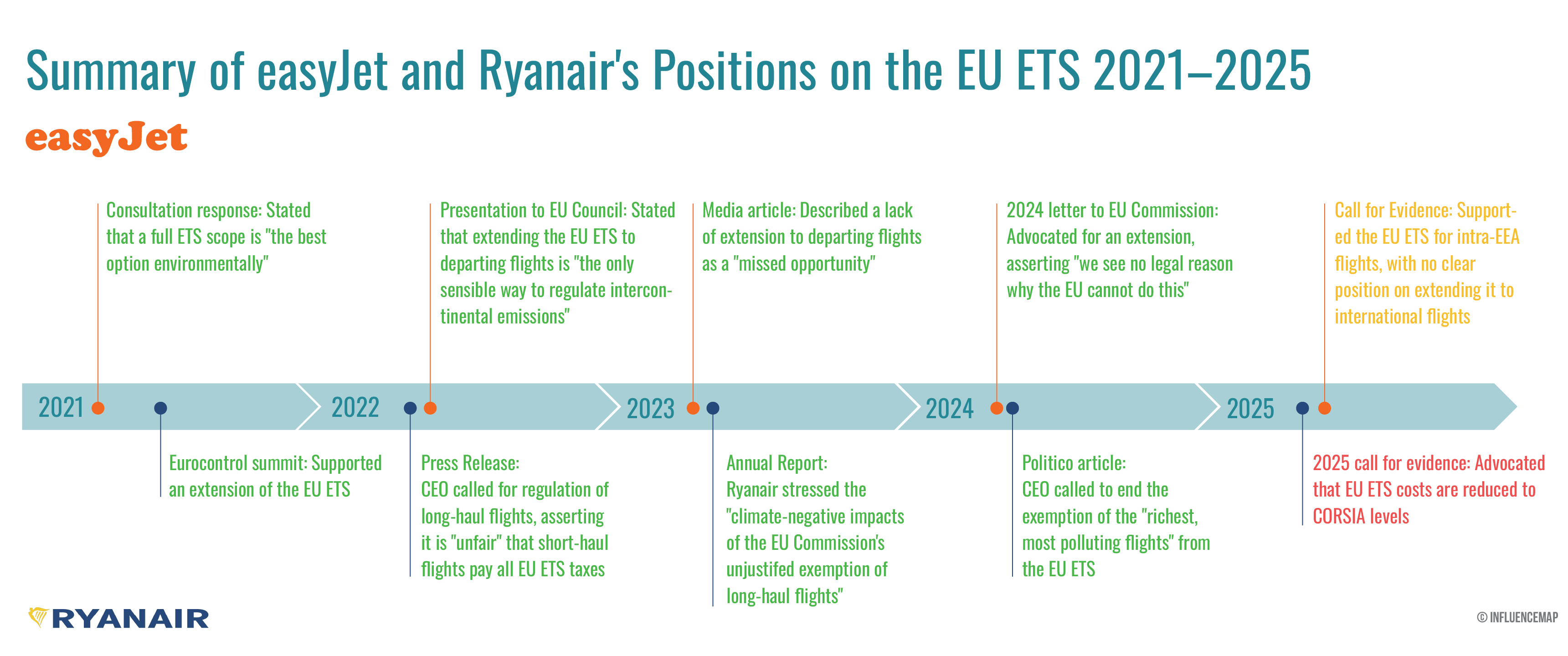
Despite previously supporting the extension of the EU ETS to all flights departing the EEA, easyJet and Ryanair did not back the extension in 2025. Ryanair instead advocated to weaken the EU ETS by excluding intra-EEA flights. At the same time, easyJet’s stance on CORSIA shifted significantly, from questioning its effectiveness to supporting its implementation, in line with industry association positions. As a result, the previously reported split between short-haul and long-haul airlines' positions on the EU ETS, observed in 2021–2024, has narrowed.
Long-haul airlines and industry associations continued to oppose the extension of the scope of the policy in 2025. Airbus and International Airlines Group (IAG) opposed applying the EU ETS to all departing flights, while Air France-KLM emphasized numerous concerns with the proposal. Airlines for America (A4A), Airlines for Europe (A4E), and the International Air Transport Association (IATA) advocated for the repeal and replacement of the EU ETS for intra-EEA flights with CORSIA, which would significantly weaken emissions reductions. A4E and IAG also advocated to effectively delay the expansion of the scope.
A small set of actors, including Schiphol Airport, Wizz Air, the SASHA coalition, and SkyNRG, continued to support expanding the ETS to all departing flights, arguing that such an expansion would provide regulatory certainty and unlock substantial climate finance.
The review of the EU ETS for aviation presents a crucial window of opportunity for the European Union to regulate emissions of all flights departing the EEA and guide the sector toward science-aligned pathways. Long-haul flights, which account for most aviation emissions, remain largely unregulated. By July 2026, the Commission will assess whether the global CORSIA offsetting scheme is sufficient to meet the goals of the Paris Agreement. If deemed insufficient, the Commission could propose extending the EU ETS to all flights departing from the EEA.
The upcoming review of the European Union’s Emission Trading System (EU ETS) for aviation marks a critical moment for global policy efforts to address growing emissions from the sector. This briefing is the first in a series analyzing the advocacy positions, narratives, and lobbying tactics used by the aviation industry to influence the policy.
Aviation accounted for 2.5% of global CO₂ emissions in 2023, with non‑CO₂ effects adding about 66% to its warming impact, and global aviation emissions grew by roughly 4% per year between 2010 and 2018, according to the Intergovernmental Panel on Climate Change (IPCC)’s AR6 Report (Chapter 10, Sections 10.5.1–10.5.2). An October 2025 Climate Action Tracker assessment “estimates that without ambitious, additional policies and actions, emissions from international aviation will more than double between 2024 and 2050.”
The Carbon Offsetting and Reduction Scheme for International Aviation (CORSIA), developed by the UN’s International Civil Aviation Organization (ICAO), aims to support the decarbonization of international aviation. CORSIA requires airlines to offset emissions above a baseline, leaving emissions below that threshold unregulated. Since its conception in 2016, the baseline has been weakened and now stands at 85% of 2019 emissions, instead of the original average of 2019–2020 emissions. Additionally, CORSIA remains voluntary until 2027, excluding flights between non-participating states such as Russia, India, Brazil, China, and Vietnam. As a result of exempted routes and the exclusion of emissions below the baseline, CORSIA is predicted to apply to less than half of international aviation CO₂ emissions between 2024 and 2035, and the IPCC has warned that “by its nature, CORSIA does not lead to a reduction in in-sector emissions from aviation” (Chapter 10, Section 10.5.3).
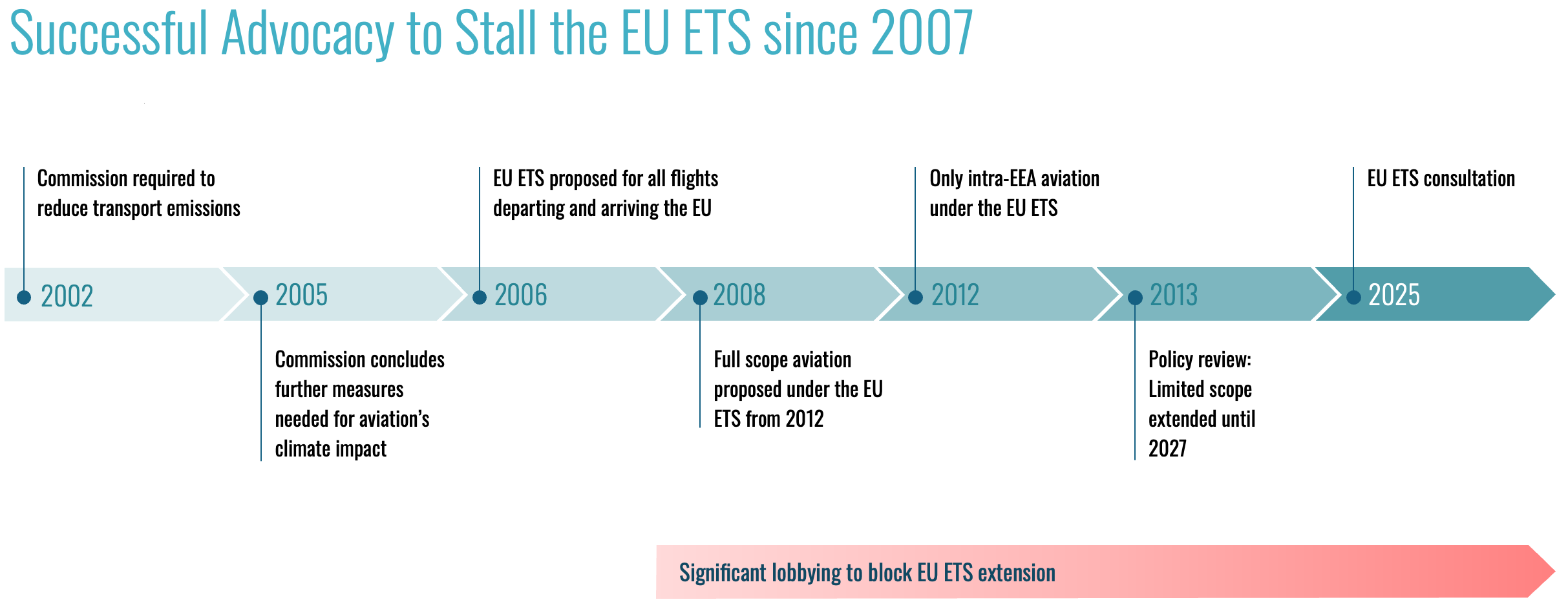
At the regional level, the EU ETS caps total emissions across covered sectors, driving emissions reductions through trading and compliance incentives. For aviation, the EU ETS was originally set to apply to all flights departing and arriving in the European Economic Area (EEA). However, the scope has been temporarily restricted since 2012, limiting the application of the EU ETS to only intra-EEA flights. Following the most recent review of the policy in 2023, and despite the EU Parliament’s support for extending the scope of the policy in June 2022, the limited application of the EU ETS was extended until 2027.
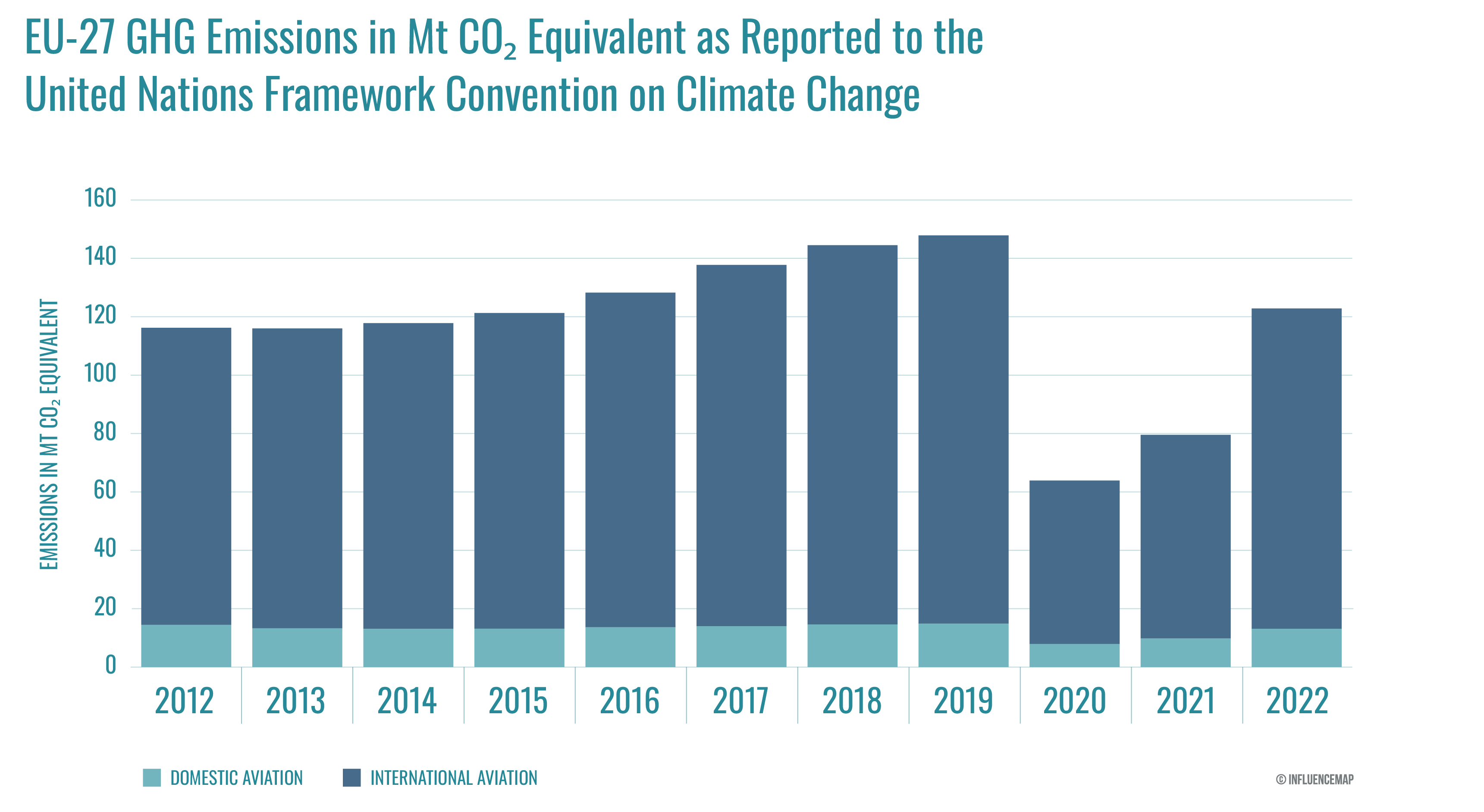
Due to the exclusion of extra-EEA flights, the majority of European aviation emissions remain effectively unregulated. The European Union Aviation Safety Agency (EASA) notes that, although long-haul flights over 4,000 km account for less than 6% of all departures in Europe, they are responsible for 46% of the EEA’s flight-related CO₂ emissions. A June 2025 study by Opportunity Green estimated that, had the EU ETS scope covered extra-EEA flights, 1.1 billion tonnes of CO₂ emissions would have been regulated between 2012 and 2023, the equivalent of Greece’s total emissions over the same period. An April 2025 Transport & Environment study reported that up to 70% of aviation carbon emissions remained unpriced in 2024, costing €7.5 billion in lost revenue that year.
By contrast, the EU’s approach to regulating emissions from shipping, a similarly “global” sector, differs dramatically. The EU ETS for maritime covers 100% of emissions from journeys between EU ports and 50% of emissions on voyages between EU and non-EU countries. This partial coverage acknowledges the sector's international nature and begins to address emissions from cross-border transport. Additionally, the European Union’s updated Nationally Determined Contribution, published ahead of COP30 in November 2025, includes 50% of emissions from voyages that start or end outside the EU.
The International Court of Justice’s July 2025 Advisory Opinion clarified that states must take decisive action under international law to reduce GHG emissions in line with the Paris Agreement’s 1.5-degree warming goal, and that states that fall short of their international obligations can be held responsible. Given aviation’s significant growth plans and the lack of binding regulation for the sector, continued delays in implementing ambitious regulation jeopardize the EU’s climate goals and the Paris Agreement.
By July 2026, the European Commission is expected to publish an assessment of CORSIA's efficacy in achieving the goals of the Paris Agreement. If CORSIA is not implemented by other states or is deemed insufficient, the Commission could present a legislative proposal to expand the geographical scope of the EU ETS to include all flights departing from the EEA. Ahead of the 2026 review, the Commission conducted a call for evidence from April to July 2025, and during the June 2025 call for evidence on the Air Services Regulation revision additional advocacy on the EU ETS occurred. Further engagement is anticipated in the lead-up to the scheduled 2026 review of the EU ETS, which constitutes a crucial window of opportunity for the EU Commission, Parliament, and Council to regulate aviation emissions in line with the original intention, as CORSIA was not meaningfully strengthened at ICAO’s 42nd assembly in October 2025.
Since the inclusion of aviation in the EU ETS, industry and international stakeholders have repeatedly pushed back, advocating to keep its scope limited to intra-EEA flights, which significantly reduces the emissions reduction potential of the policy.
In 2002, the European Parliament and the Council of the European Union required the Commission to reduce transport GHG emissions by implementing “specific measures” to reduce aviation emissions if ICAO failed to adopt such measures. In 2005, the Commission concluded that further measures were needed to address aviation’s projected growing climate impact. In 2006, it first proposed extending the EU ETS to all flights departing and arriving in the EU. This was based on an impact assessment that found the broadest geographical scope would deliver the greatest environmental benefits and ensure competitive neutrality. Both the Parliament and Council approved the Commission's full-scope proposal and, in 2008, decided to include aviation in the EU ETS from 2012.
Meanwhile, the aviation industry began its long-standing opposition to the policy. A 2007 article disclosed that Lufthansa threatened to shift its operations outside the EU to Zurich if the Commission implemented the EU ETS. A 2008 diplomatic cable between the US Mission to the EU and the US Department of Transport revealed that, while Air France initially supported the full scope of the ETS, it reversed its position over cost concerns, and further reported that Lufthansa’s strategy focused on “letting the US sink the ETS.” In 2009, a group of US airlines backed by the International Air Transport Association (IATA), including American and United, legally challenged the EU’s decision to apply the EU ETS to extra-EEA flights, arguing that it breached the Chicago Convention, a 1944 treaty that set the rules and framework for international civil aviation. In December 2011, the European Court of Justice upheld the legality of the EU ETS’s application to extra-EEA flights under international law and confirmed it did not have extraterritorial effect as obligations are not imposed on other states.
Over 20 countries including Russia, China and the US met three times over 2011–12 to voice their opposition to including non-European airlines in the policy, advocating for an alternative global solution initiated at the ICAO level. Subsequently, in November 2012, the EU temporarily suspended the scheme’s application to extra-EEA flights, known as “stop the clock,” pending progress at the ICAO level. In a letter sent the same month to a Chinese policymaker, Airbus welcomed the temporary suspension of the measure and stated that it had actively engaged with the European Commission and several national governments to delay the inclusion of all international flights. Also in November 2012, the US enacted the "EU ETS Prohibition Act," directing the Department of Transport to block US airlines from participating in the EU ETS if deemed in the public interest. However, its enforceability has since been questioned: a 2012 op-ed by the Brookings Institute noted that if the government blocked compliance with the EU ETS, it would have to reimburse airlines for any resulting penalties — costs that would be passed on to taxpayers. A November 2025 legal analysis by Opportunity Green found that the EU ETS can legally be applied to all international flights and does not contravene international law. Additionally, a 2021 legal analysis commissioned by Transport & Environment concluded that international aviation emissions are implicitly covered by the Paris Agreement (Article 4.1) and therefore should be included in a nation’s UNFCCC Nationally Determined Contribution.
Low-cost airlines’ previous support for expanding the EU ETS appeared to shift in 2025, while legacy airlines and industry associations continued to maintain their long-standing objections. Consequently, the support base for the EU ETS has diminished, and a more unified position from the EU aviation industry has emerged. This push comes amid growing opposition from the aviation industry to other key climate policies needed to decarbonize the sector, both globally and within the EU.
From 2021 to 2024, easyJet and Ryanair actively called for an extension of the EU ETS scope. However, in 2025, easyJet and Ryanair shifted their positions, reducing visible support for the extension while adopting positions more closely aligned with those taken by the sector’s industry associations.
easyJet and Ryanair did not actively support an extension. In its July 2025 response to the European Commission's call for evidence, easyJet supported applying the EU ETS to intra-EEA flights but took no clear position on expanding it to all international flights. While Ryanair continued to emphasize the “unfair” costs on intra-EU flights compared to extra-EU flights in its June 2025 response to the EU Air Services Rules, it did not advocate resolving this through a scope extension.
Ryanair instead advocated to weaken the EU ETS for intra-EEA flights. In its June 2025 response, Ryanair advocated that EU ETS costs be aligned with CORSIA, a position also pushed by A4E. This would significantly reduce the cost of intra-EEA aviation emissions, lowering the incentive to reduce emissions and the potential revenue available for climate action. A November 2024 Carbon Market Watch study reported that, in 2022, a tonne of CO₂ was priced at €80 under the EU ETS, while it averaged €3.20 under CORSIA credits. However, in a January 2026 Politico article, the CEO of Ryanair supported an extension of the EU ETS scope, as an alternative to passenger taxation, but stated this is “never going to happen while Trump is at the White House”.
easyJet’s position on CORSIA also shifted, aligning more closely with key industry associations’ positions.1 In its July 2025 call for evidence response, easyJet called for a “global solution” and, while recognizing that CORSIA currently “falls short,” advocated for a “strengthening of CORSIA”. IATA similarly supported a “global approach” while A4A and A4E called for a stronger CORSIA in July 2025 regulatory feedback. In contrast, easyJet described CORSIA as having “less emissions impact than if easyJet changed the trolleys on its aircraft” and claimed that ICAO processes were “set up to fail” in an August 2022 presentation to the EU Council.
Meanwhile, the sector’s industry associations, legacy airlines, and Airbus maintained long-standing opposition to the expansion of the scope in 2025.
Airbus and IAG continued to oppose the scope extension, while Air-France KLM emphasized numerous concerns with the proposal. The CEO of Air France-KLM, Ben Smith, criticized applying the EU ETS to all departing flights at a June 2025 conference. KLM also raised concerns about the extension in a September 2025 meeting with EU policymakers. In its July 2025 response to the EU ETS call for evidence, IAG opposed extending the scope to long-haul flights. Airbus opposed the application of the EU ETS to all or departing extra-EEA flights, stating it conflicts with CORSIA, in the June 2025 EU Air Services Rules call for evidence.
Industry associations advocated for CORSIA to replace the EU ETS on intra-EEA flights. In their responses to the 2025 EU ETS call for evidence, A4A, A4E, and IATA advocated in favor of replacing the EU ETS with CORSIA for international intra-EEA flights, repealing the EU ETS's current scope. IATA also questioned the legality of extending the scope in its response. Replacing the EU ETS for intra-EEA flights with CORSIA would significantly curb emissions reductions. Under CORSIA, only emissions above 85% of 2019 levels must be offset, whereas under the EU ETS, airlines must purchase allowances to emit reported CO₂. Capped allowances decrease over time, incentivizing airlines to decarbonize.
A4E and IAG advocated to delay the review of the EU ETS extension. In response to the July 2025 EU ETS call for evidence, IAG and A4E urged the European Commission to delay its planned 2026 review of CORSIA, arguing that an assessment of the scheme would be “premature”. Considering that the Commission’s decision on the policy's geographical scope depends on CORSIA's review, delaying the review would effectively delay any potential extension. IAG specifically suggested delaying the extension until 2030 to allow for an assessment in 2029. The aviation industry, including A4E and IAG, previously endorsed a significant rollback of CORSIA by shifting the baseline from 2019–20 emissions to 2019 emissions only. ICAO adopted this amendment, considerably reducing the proportion of emissions that the sector is required to offset.
In contrast to the increased uniformity in the aviation sector’s positioning on the EU ETS, InfluenceMap’s July 2022 “Airlines and European Climate Policy” report revealed a significant split between advocacy by legacy airlines and industry associations and advocacy by low-cost carriers on extending the EU ETS to extra-EEA flights in 2021–22. A comparison of evolving aviation industry positions between 2021–22 and 2025 is outlined in the table below.
Despite the shift in easyJet and Ryanair’s positions in 2025, other actors supported extending the scope:
Wizz Air supported an extension between 2022–2025, including in a February 2022 joint statement and in its 2025 Annual Report, published in June 2025.
Schiphol Airport disclosed that it lobbied the European Parliament and the European Commission to extend the EU ETS to cover intercontinental flights in its 2024 Annual Report, published in 2025.
The SASHA coalition argued that the expansion would provide regulatory certainty and could help fund renewable hydrogen. The alliance of companies from the shipping and aviation sectors promoting green hydrogen and Direct Air Capture supported the scope extension in the July 2025 call for evidence on the EU ETS.
Sustainable aviation fuel producer, SkyNRG stated that CORSIA “lacks the ambition needed to drive meaningful change” and that the ETS expansion is necessary to align aviation with the Paris Agreement in its response to the 2025 EU ETS call for evidence.
At the same time, opposition from the aviation industry to other key climate policies required to decarbonize the sector, both globally and in the EU, grew in 2025.
Despite prior support from the aviation industry as recently as November 2023, many airlines publicly expressed doubt about achieving a 2050 net-zero goal in 2025. In an October 2025 article, Ryanair CEO Michael O’Leary claimed “we’re not going to get to net zero by 2050,” and in a March 2025 article, Airbus’ CEO stressed that the goal may “take a bit more time.” Alongside this, in an April 2025 article, IATA’s CEO, Willie Walsh, called for the target to be “reevaluated,” citing growing concern among airline CEOs about rising costs.
Airlines are also increasingly critical of the EU’s sustainable aviation fuel (SAF) mandate in the first year of its implementation. During the A4E summit in April 2025, Air France-KLM CEO and A4E Chair Ben Smith stated that “the SAF does not exist, ... we don’t see a path toward the amount we need to reach the mandate.” Ryanair CEO Michael O’Leary went further, advocating to delay the EU SAF mandate. IATA has also frequently opposed the EU SAF mandate, including in a December 2025 press release.
These oppositional positions emerged after the industry leveraged the promise of SAF as the cornerstone of its decarbonization plans for years, with IATA claiming that SAF will deliver 62% of aviation’s emissions reductions by 2050. The industry has used this narrative to oppose binding climate policies, with many players suggesting that regulatory measures are unnecessary because SAF will facilitate the sector’s decarbonization. For example, in a June 2025 call for evidence, Airbus dismissed environmental flight bans as ineffective and advocated for a “technology-driven” approach, including SAF.
| Industry Associations | Membership to A4E | Membership to IATA | Membership to A4A | |
|---|---|---|---|---|
| Companies | InfluenceMap Performance Band (Global) | C- | D | D- |
| easyJet | C+ | |||
| Wizz Air | C+ | |||
| Airbus | C | Strategic partner | ||
| Air France-KLM | C- | The CEO is the Chair | The CEO is on the board | |
| Lufthansa | D+ | |||
| Ryanair | D+ | |||
| International Airlines Group | D+ | The CEO is Chair of the Board |
1 All analyzed corporations, excluding Wizz Air, are members of Airlines for Europe (A4E), while Lufthansa, International Airlines Group (IAG), and Air France-KLM are members of the International Air Transport Association (IATA). While Airlines for America (A4A) represents US carriers rather than EU airlines, it has actively engaged on the extension. See Appendix A for a list of industry association memberships.