New analysis of the 2024 emissions data for companies in the Carbon Majors database reveals that their emissions increased in 2024 compared to 2023 and that production continues to consolidate among an increasingly small number of entities. State-controlled (1) fossil fuel producers remain dominant, representing 17 of the top 20 emitters, underscoring the political barriers to accelerating climate action.
At COP30 last year, a coalition of more than 80 countries proposed a roadmap to transition away from fossil fuels, but this plan was blocked by strong opposition from major producing states. The Carbon Majors database shows that 17 of the top 20 emitting Carbon Majors are controlled by governments that formed this opposition: Saudi Arabia, Russia, China, Iran, United Arab Emirates, Algeria, Iraq, Qatar, and India. These 17 emitters produced 38% of fossil fuel and cement CO₂ emissions in 2024. The remaining three of the top 20 emitters were UK-based Shell, and US-based Chevron and ExxonMobil. Notably, the United States did not attend the COP30 summit.
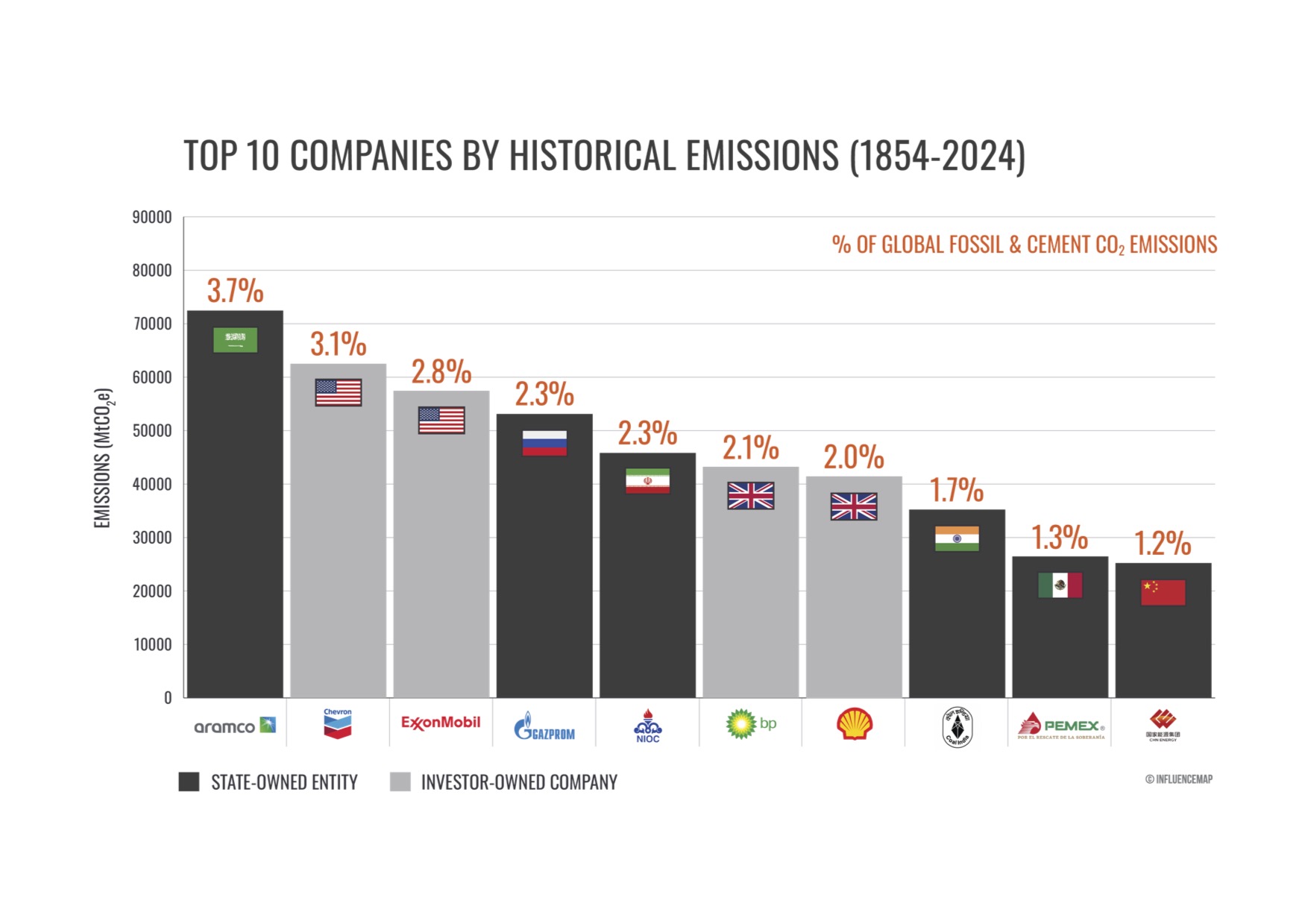
The Carbon Majors dataset is the only dataset of its kind, tracking emissions from the world’s largest oil, gas, coal, and cement producers going back to 1854. Now updated with 2024 data, this new analysis reveals that 70.0% of anthropogenic fossil CO₂ emissions since the start of the Industrial Revolution can be traced to the 178 corporate and state-producing entities in the database. Over this period, just 22 companies accounted for one-third (33.4%) of global fossil CO₂ emissions.
Multiple peer-reviewed studies published in the last year used Carbon Majors data and attribution science to link corporate emissions to a wide range of real-world impacts—highlighting the severe and long-lasting effects of greenhouse gases in the atmosphere. Key findings include that emissions from the 178 Carbon Majors entities made 213 heatwaves reported between 2000 and 2023 more likely and more intense, and that these emissions contributed to nearly half of the increase in present-day surface temperatures, as well as approximately one-third of observed global sea-level rise. Additionally, researchers were able to attribute trillions of dollars in extreme heat-related economic losses to individual fossil fuel companies in the database, including linking between $791 billion and $3.6 trillion in damages from 1991 to 2020 to Chevron’s emissions alone.
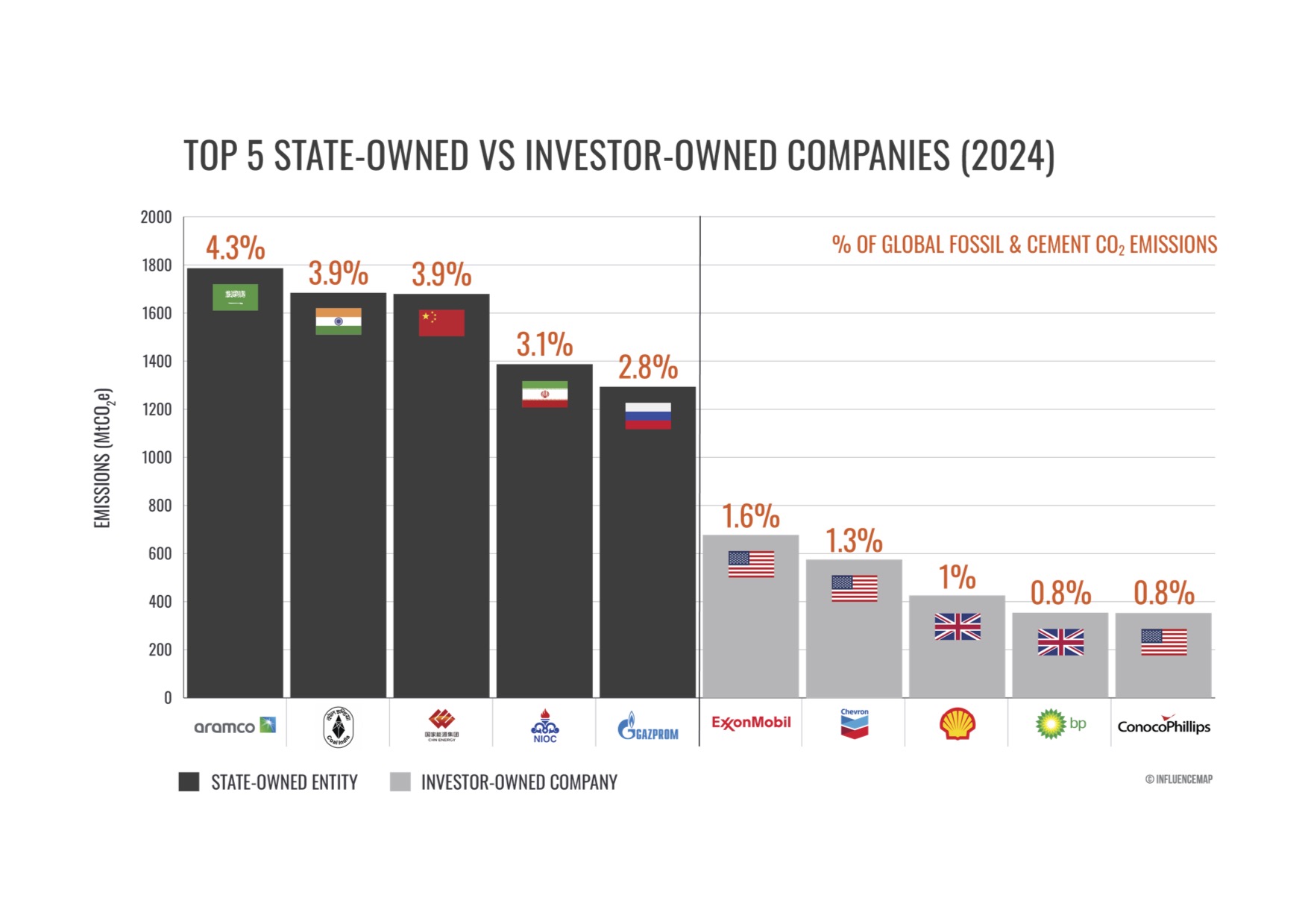
In 2024, the top five state-owned emitters—Saudi Aramco, Coal India, CHN Energy, National Iranian Oil Co., and Gazprom—were responsible for 18.0% of global fossil fuel and cement CO₂ emissions (7.8 GtCO₂e). Notably, Coal India, CHN Energy, National Iranian Oil Co, and Gazprom all increased their emissions in 2024 compared to 2023.
The top five investor-owned emitters—ExxonMobil, Chevron, Shell, BP, and ConocoPhillips—accounted for 5.5% of global fossil fuel and cement CO₂ emissions in 2024 (2.4 GtCO₂e).
Accountability mechanisms grounded in historical corporate emissions have gained significant momentum over the last year, with the Carbon Majors database providing a core evidentiary resource for efforts by governments, courts, and researchers worldwide. In the United States, Carbon Majors underpins Climate Superfund laws in Vermont (passed in May 2024) and New York (passed in December 2024), with similar proposals at various stages in over ten additional states. Internationally, the database featured prominently in Lliuya v. RWE, a landmark German climate litigation case in which the court recognized that companies can, in principle, be held liable for climate-related harm based on attribution evidence connecting emissions to specific producers. Carbon Majors was also cited by the Inter-American Court of Human Rights Advisory Opinion on Climate Emergency and Human Rights, which found that a small group of corporate producers bears disproportionate responsibility for historical global emissions and that states have a duty to regulate corporate climate harms on human rights grounds.
Emmett Connaire, Senior Analyst at InfluenceMap, said::
The Carbon Majors database demonstrates that each year, global emissions become increasingly concentrated among a shrinking group of high-emitting producers, while overall production continues to grow. Simultaneously, these heavy emitters continue to use lobbying to obstruct a transition that the scientific community has known for decades is essential. The latest updates to the database underscore the growing importance of this kind of rigorous evidence in efforts to determine accountability for climate-related losses. By providing the link between corporate activity and climate impacts, Carbon Majors turns scientific findings into action across the legal, legislative, and regulatory landscapes.
Christiana Figueres, Former UNFCCC Executive Secretary and Co-Founder of Global Optimism, said:
The latest Carbon Majors data shows once again that large emitters are on the wrong side of history. When we need to accelerate progress to the clean energy future that would give us greater energy security, affordability and freedom, these emitters continue to block our way. While clean energy and electrification is already receiving nearly twice the investment of fossil fuels globally, carbon majors are clinging on to outdated, polluting products and continue to mislead the public on the urgent real-world consequences of their actions. But they cannot hold us back for long. This data provides a tool for the growing majority who are coming together to champion science-backed solutions and accountability, and who are filled with excitement for the electrified future that’s already being built with collaboration, purpose and determination.
Tzeporah Berman, Chair and Founder of the Fossil Fuel Treaty Initiative, said:
The latest Carbon Majors analysis reinforces a stark reality: a powerful, concentrated group of fossil fuel corporations are not only dominating global emissions but are actively sabotaging climate action and weakening government ambition. Their increasing output and blatant opposition to a fossil fuel phase-out, as witnessed at COP30, reveal a systemic barrier to progress. This is precisely why a Fossil Fuel Treaty is not merely an option, but the indispensable mechanism to hold these giants accountable, break their stranglehold on climate policy, and ensure a fast and fair global transition away from the products threatening our very existence: oil, gas, and coal. In the Colombian city of Santa Marta this April, those ready to act will gather to discuss the roadmap for this urgent transition, a critical step towards securing a truly sustainable future for all.
Click here to read the full report
Kitty Hatchley, Media Manager, InfluenceMap (London)
Email: kitty.hatchley {@} influencemap.org
(1) The 17 state-controlled producers include one aggregate entity for China’s cement production and 16 state-owned companies: Saudi Aramco, Coal India, CHN Energy, National Iranian Oil Co., Gazprom, Jinneng Group, Rosneft, CNPC, Shandong Energy, China National Coal Group, Shaanxi Coal and Chemical Industry Group, Abu Dhabi National Oil Co., Sonatrach, Iraq National Oil Co., Shanxi Coking Coal Group, and QatarEnergy.