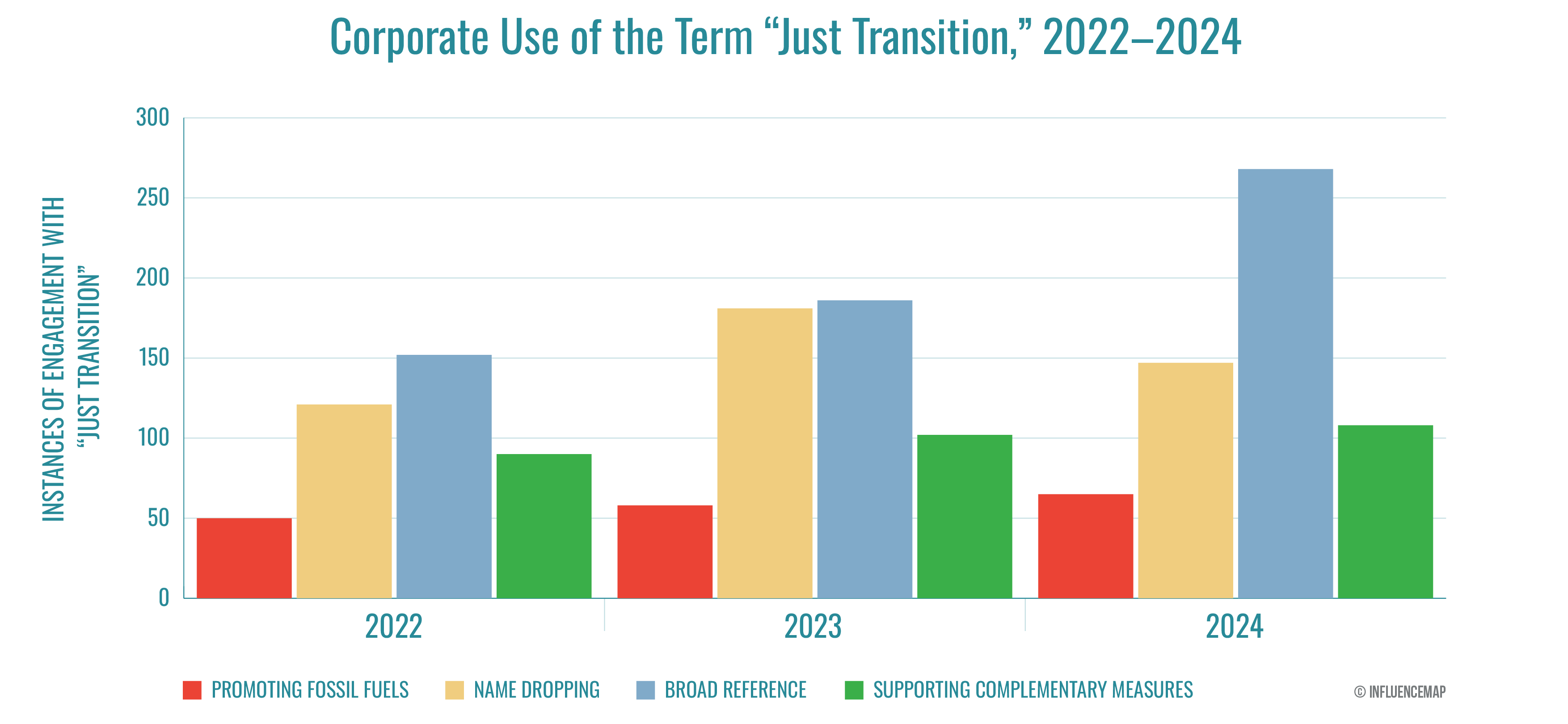
- The majority (69%) of company and industry association communications tracked made only vague references to a “just transition” and did not meaningfully engage with the concept.
- Only one-fifth (20%) of company and industry association communications combined their use of “just transition” with clear support for an urgent transition away from fossil fuels and operational measures to drive an equitable transition.
- However, 11% of company and industry association communications tracked leveraged just transition language to argue for an extended role for fossil fuels in the energy mix.
New InfluenceMap analysis of use of the term “just transition” in public-facing communications by the world’s largest companies and industry associations reveals that widespread nonspecific corporate references to a “just transition,” combined with some entrenched industries’ use of the term to promote fossil fuel use, risk diluting its meaning
altogether.
As country delegates, policymakers, and civil society gather in Belém for COP30, the Belém Action Mechanism for a Global Just Transition (BAM) is at the forefront of negotiations and would provide a crucial roadmap to ensure that no one is left behind—including front-line workers and communities—in the transition away from fossil fuels. It is important that this key part of the energy transition is not undermined by corporate misuse of just transition language. As such, highlighting how its key terms are being deployed is critical.
InfluenceMap found 292 companies and industry associations in the LobbyMap database used the term “just transition” in their public-facing communications between 2022 and 2024. For this narrative analysis, use of the term “just transition” by these entities was categorized into four groups: Promoting Fossil Fuels, Name Dropping, Broad
Reference, and Supporting Complementary Measures.
Between 2022 and 2024, the number of references to a “just transition" increased overall. While the use of "just transition” in both the context of promoting fossil fuels and alongside support for complementary measures rose gradually, broad references to the term in these corporate communications increased significantly.
The findings:
- The majority (69%) of companies’ and industry associations’ public communications that referenced “just transition” were vague and were not accompanied by meaningful engagement with the concept, falling into either the Name Dropping (29%) or Broad Reference (40%) categories. The energy sector leads this overreliance on high-level language, accounting for over a fifth of engagement across both categories. The lack of practical and technical details on what is required for a just transition in these contexts, especially from the sector at the center of the energy transition, risks undermining stakeholder understanding of the term.
- 20% of the dataset consisted of communication that engaged with the term “just transition” in a meaningful way, expressing clear urgency to both transition away from fossil fuels in line with IPCC timelines and ensure social protections for vulnerable workers and communities. However, further inspection of this data highlights reasons for caution. First, companies that have discussed “just transition” in a meaningful way do not always communicate consistently on the topic. Second, the LobbyMap platform finds that some of these companies also lobby against science-aligned policy pathways in other contexts.
These tensions may suggest that such companies have a stake in the benefits of a just transition for their employees and businesses, yet treat it as a secondary priority to promoting their immediate interests in fossil fuels.
- 11% of communications used just transition language to argue for an extended role for fossil fuels in the energy mix. InfluenceMap finds that the energy and utilities sectors are the most prominent in this category. In their discussion of a just transition, these entities regularly employ a series of sub-narratives closely tied to the fossil fuel playbook. According to the dataset, the most common sub-narratives within this category attempt to label fossil fuels as “just transition” fuels and emphasize that fossil fuels are necessary for energy security and affordability.
Jennifer Gullery, Senior Analyst at InfluenceMap, said:
This research demonstrates how corporate actors have recognized the value in using the term “just transition” in order to build public and policymaker trust. However, most of these communications lack any demonstration of, or commitment to, robust action for driving that just transition. Furthermore, actors within the fossil fuel value chain are shown to have actively co-opted just transition language to slow the energy transition and promote fossil fuels. As civil society and policymakers come together to push national governments to prioritize the development of a mechanism that would ensure a global just transition away from fossil fuels, positive corporate actors must also play a role, backing up their communications with real-world policy action and detailed support to ensure no one is left behind.
Click here to read the research in full
For further information or to arrange interviews, please contact:
Kitty Hatchley, Media Manager, InfluenceMap (London)
Email: kitty.hatchley {@} influencemap.org