Next week, the seventh session of the United Nations Environment Assembly (UNEA) will be convened. This is likely to be a key moment in the evolution of the Global Plastics Treaty (the Treaty) as the assembly is due to hear a progress report on the Treaty and decide on next steps for the negotiations. New research from InfluenceMap, released to coincide with this moment, reveals how intense chemical and petrochemical industry lobbying contributed to the collapse of negotiations in August this year, demonstrating how these sectors continue to block progress on tackling the key global problem of plastic pollution.
The findings show how persistent engagement from a minority of sectors using well-rehearsed fossil fuel industry arguments appears to have overwhelmed otherwise broad business support for a strong agreement on plastics. Negative advocacy on the Treaty from the chemical and petrochemical sectors was particularly focused on pushing back against production limits and bans on hazardous plastics—the key points over which the negotiations failed to reach a conclusion. This advocacy is consistent with InfluenceMap’s previous analysis of engagement on the Treaty up to November 2024, which documented significant opposition from the chemical and petrochemical sectors.
InfluenceMap’s database covers 1000 of the world's largest companies and 350 of the most prominent industry associations. Of these, InfluenceMap found public engagement on the Treaty from 42 companies and 21 industry associations since the conclusion of INC-5.1 in December 2024, up to and including INC-5.2 in August 2025. According to the UNEP list of participants, at least 21 of these organizations were present in Geneva, with a total of 50 representatives, seven of whom were from the American Chemistry Council.
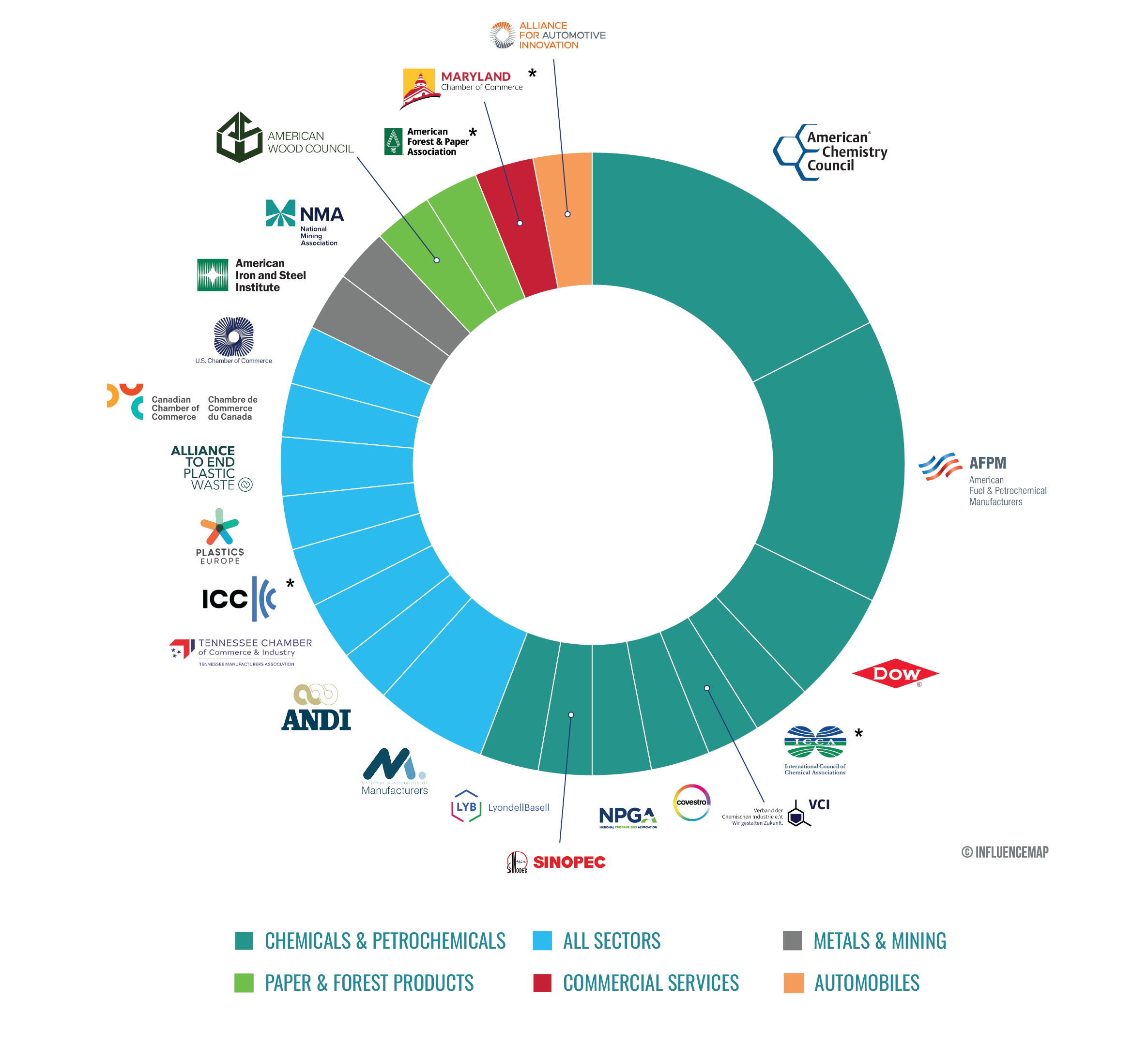
Analysis of these entities finds that 56% of negative lobbying came from companies and industry associations in only two sectors, the chemical and petrochemical sectors. Negative companies include LyondellBasell, Covestro, and the China Petroleum & Chemical Corporation (Sinopec). Negative industry associations were the most highly engaged, with almost half of the negative advocacy tracked (41%) coming solely from five key players: the American Fuel & Petrochemical Manufacturers (AFPM), the American Chemistry Council (ACC), the German Chemical Industry Association (VCI), the US National Propane Gas Association (NPGA), and the International Council of Chemical Associations (ICCA). A further 26% of negative engagement came from cross-sector industry associations, many of which have chemical and petrochemical companies as members, such as the National Association of Manufacturers (NAM) and the US Chamber of Commerce. InfluenceMap analysis repeatedly finds that, although these cross-sector groups have memberships that span all sectors of the economy, their lobbying positions on climate most often reflect those of their most negative members.
Conversely, positive engagement on the Treaty came from companies representing a wide range of sectors, including consumer goods, retail, healthcare, financial services, and industrials. This engagement was predominantly coordinated by The Business Coalition for a Global Plastics Treaty (the Coalition), which represents 36 of the 39 positive entities identified, but publicly engaged only 5 times over the period. This is compared to the 19 negative industry groups, which engaged 17 times. By leaving positive engagement predominantly to one group and, for the most part, not engaging directly alongside it, companies that are in favor of an ambitious Treaty have put themselves at a significant disadvantage.
The limited impact that positive corporate voices have had on the negotiations so far might also point to internal challenges within such coalitions in fostering broad, cross-sector agreement on key positions and narratives. Notably, 21 companies that are part of the Coalition are also members of one or more industry associations that engaged negatively on the Treaty, including 3M, PepsiCo, Coca-Cola, Novo Nordisk, Uber, and Walmart. This suggests that some companies that are supporting a binding Treaty on plastic pollution via the Coalition are also indirectly contributing to efforts to weaken it.
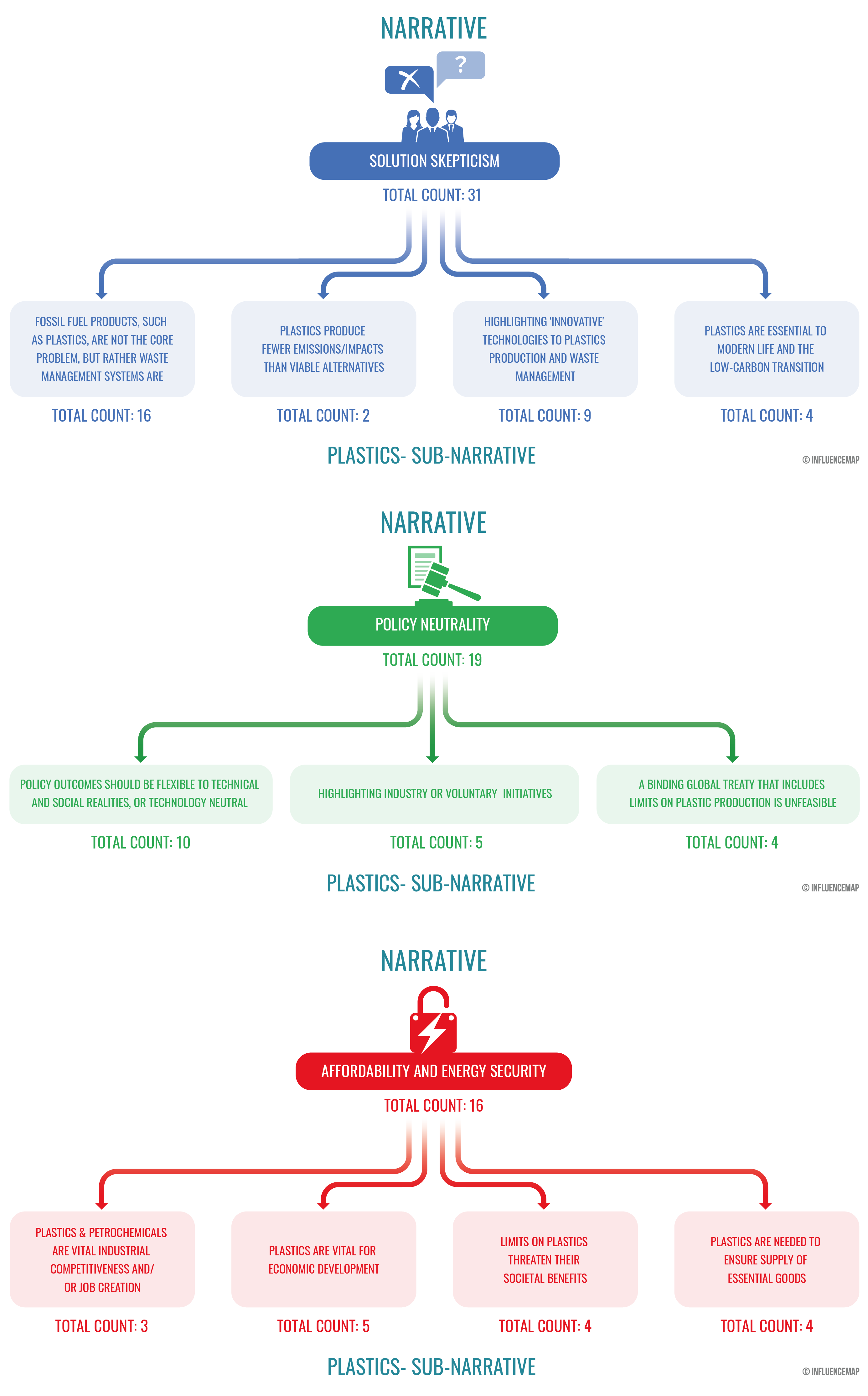
A detailed assessment of the narratives used in negative engagement on the Treaty shows that companies and industry associations in the chemical and petrochemical sectors deployed well-worn fossil fuel talking points, adapted for the plastics context, to make their arguments and preserve a market for fossil fuels in the plastics value chain. These arguments—which previous InfluenceMap research has shown contrast with the findings of the Intergovernmental Panel on Climate Change but have been used for at least the last 60 years—can be grouped into three main narrative threads: (1) “Solution Skepticism” which downplays the viability of alternatives to fossil fuels and their products, as well as the negative impacts associated with their use; (2) “Policy Neutrality,” or promoting technologically “neutral” solutions that leave room for the status quo; and (3) arguments around “Affordability and Energy Security.”
As shown in Figure 2, in the context of the Treaty, these were presented as (1) minimizing the need to limit plastic production or promoting waste management, such as recycling, as an optimal solution, (2) promoting voluntary or “flexible” policy approaches, and (3) framing plastics as essential for economic and social outcomes. These narratives closely mirror public communications from nations present in Geneva in August, including from Russia, Saudi Arabia, and the US, which all made statements echoing familiar petrochemical sector arguments to limit the Treaty’s scope.
Rose Harris, Analyst at InfluenceMap, said:
The collapse of the Global Plastics Treaty negotiations is a clear example of the destructive power of strategic and intense vested interest lobbying on international processes. The chemical and petrochemical sector arguments are not new, nor are they incontestable, but until their unrelenting efforts are matched by positive actors from the rest of the economy, they will continue to win out on this issue. Unless international decision-making bodies like UNEA address negative influence head-on, the world risks losing one of the most important opportunities to tackle plastic pollution at its source.
Click here to access InfluenceMap's COP Platform
Kitty Hatchley, Media Manager, InfluenceMap (London)
Email: kitty.hatchley {@} influencemap.org