InfluenceMap analysis finds that cross-sector and fossil fuel industry groups have recently ramped up their deregulatory appeals to Congress, with an increase in advocacy before and after the October–mid-November government shutdown. These industry groups have endorsed legislation—such as the SPEED and PERMIT Acts—that target the rigor and scope of the National Environmental Policy Act (NEPA) and Clean Water Act (CWA), respectively.
Given the current federal administration’s favor toward fossil fuels and opposition to wind and solar power, measures to remove safeguards from the permitting process may expedite fossil fuel projects that increase greenhouse gas (GHG) emissions and threaten biodiversity. The Trump administration has already taken aim at NEPA by repealing its implementing regulations earlier this year, allowing agencies to develop their own guidance that could weaken the law’s consistency and impact without oversight from the Council of Environmental Quality. The House could vote on the SPEED Act as early as today, December 18th; in the lead-up, civil society has amplified its calls for policymakers to reject the bill, with over 150 organizations signing a December 15th letter in opposition. The PERMIT Act is now in the Senate Committee on Environment and Public Works.
The December 2024 Nexus Report by the Intergovernmental Platform on Biodiversity and Ecosystem Services (IPBES) finds that human activity is driving biodiversity loss at an unprecedented rate and that urgent action is needed worldwide. The report emphasizes five direct drivers of biodiversity loss, four of which are exacerbated by fossil fuel extraction: land use change, climate change, overexploitation of resources, and pollution. In particular, it notes how “nature overexploitation scenarios” are characterized by “unsustainable energy demand, including but not limited to demand for fossil fuels.” Meanwhile, the 2019 IPBES Global Assessment Report points to surface mining as a driver of “land-cover change (and) pollution” and notes that “climate has changed since pre-industrial times due to anthropogenic activities,” referring particularly to those that “raise greenhouse-gas emissions.”
Under a pro-fossil fuel federal administration, permitting reform that removes critical safeguards from the approval process—including rigorous review, ample time for legal challenges, and community involvement—may enable increased fossil fuel extraction. In particular, the SPEED Act would weaken provisions of the National Environmental Policy Act, paving the way for extractive projects that risk increased land degradation and the overexploitation of resources. Proposals to reform the Clean Water Act, meanwhile—particularly the weakening of Section 401 that grants permits to discharge into federal waters—risk increased pollution and associated biodiversity loss.
InfluenceMap is tracking cross-sector and industry advocacy for these deregulatory measures on its live policy tracker here. From this analysis, several patterns stand out:
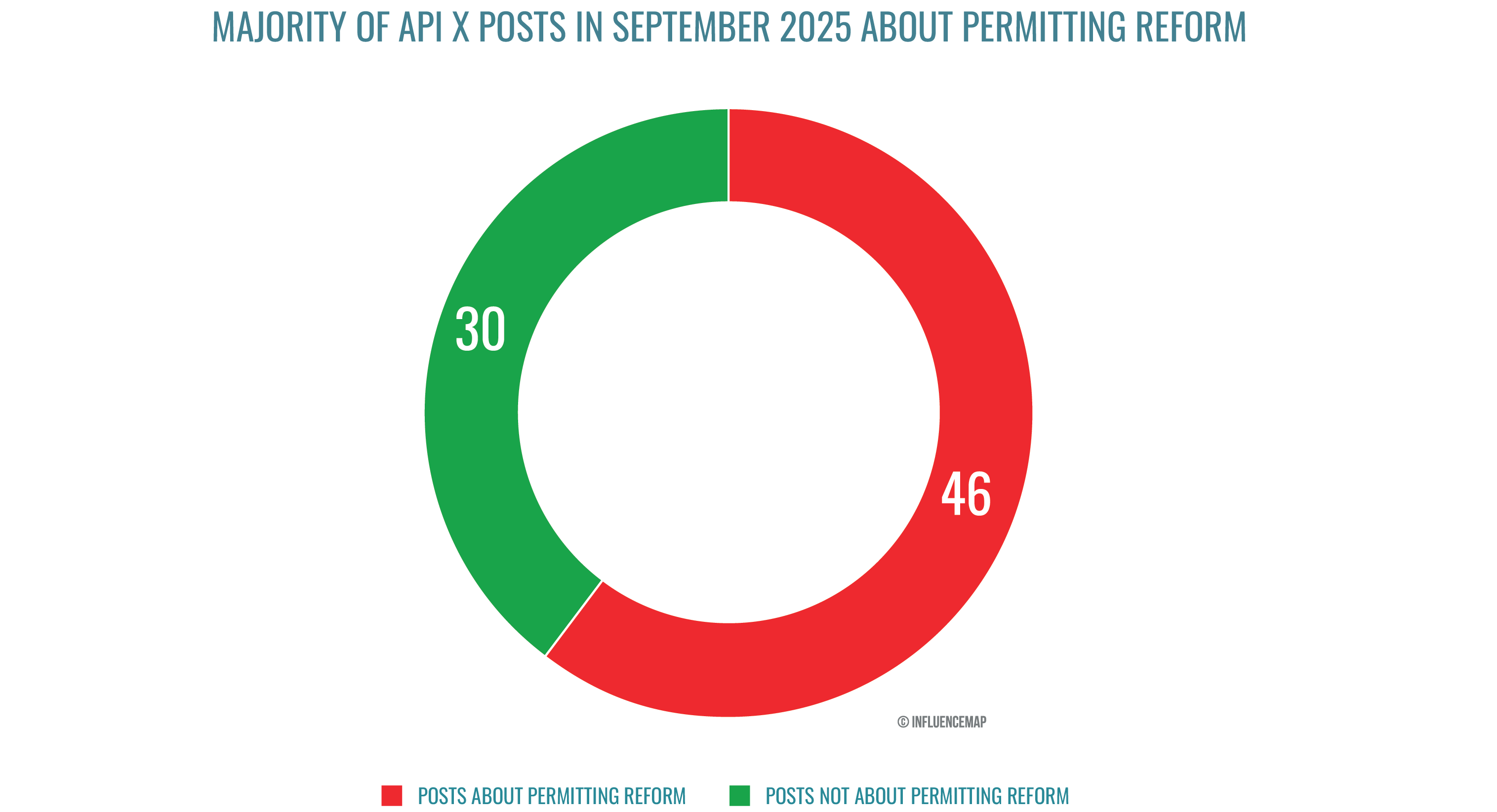
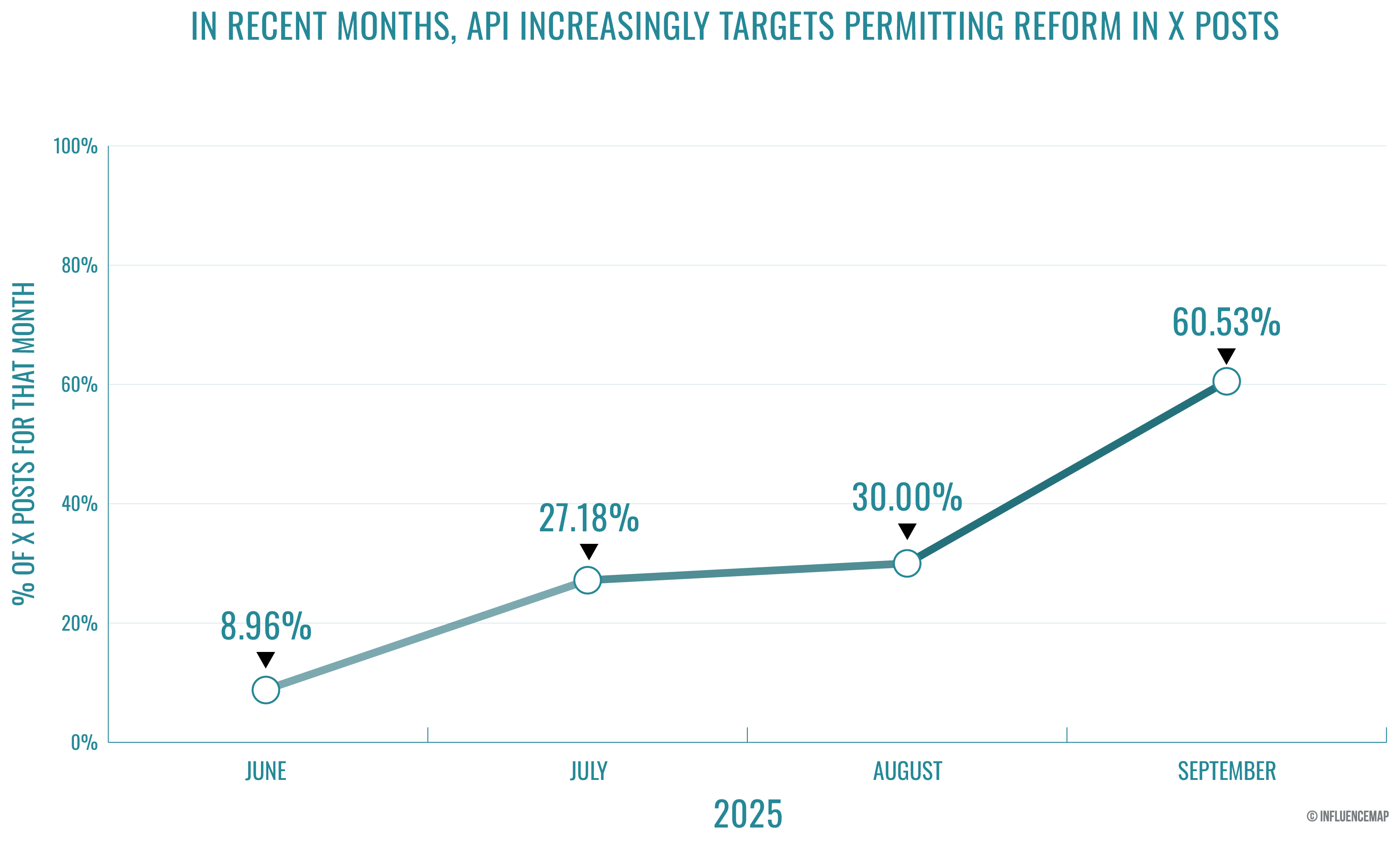
American Petroleum Institute (API) continues to spearhead the permitting reform push, using claims that fossil fuels are necessary to national security and the Trump administration’s energy/artificial intelligence dominance agenda. In a September 23 Fox News article, CEO Mike Summers publicized the group’s seven-figure advertising campaign to promote its policy roadmap, which urges Congress to pursue policy solutions that weaken both NEPA and CWA. In an apparent effort to influence public opinion on the topic, API intensified its focus on permitting reform on social media in September 2025—on its X account, mentions of permitting reform have surged since the summer. Following this, in October 2025, API hosted a conference on permitting reform with key federal policymakers in attendance, including Secretary of the Interior Doug Burgum, Senator Capito, and Representative Westerman, who introduced the SPEED Act in the House. Meanwhile, API’s advocacy group Energy Citizens is urging the public to call for bipartisan permitting reform under its “When America Builds, America Wins” campaign, alongside other campaigns, including one to expand federal offshore oil and gas leasing.
Other industry groups are also doubling down on pro-fossil fuel narratives in their advocacy for permitting reform. Among others, API, Business Roundtable, National Association of Manufacturers, and the Natural Gas Council—composed of API, American Gas Association, Independent Petroleum Association of America, Interstate Natural Gas Association, and Natural Gas Supply Association—are calling for legislative measures to weaken and expedite the NEPA and CWA processes in the interest of fossil fuel expansion, frequently leveraging fossil fuel narratives around energy security and affordability to do so. These industry groups have paired these narratives with similar requests to weaken and expedite the permitting process, emphasizing “predictable” approvals of fossil fuel energy projects that are immune to “getting bogged down in litigation for years.” These narratives contradict Intergovernmental Panel on Climate Change guidance, which is clear that further fossil fuel extraction will lead to overshoot of the 1.5°C mitigation pathways (AR6 Report, Chapter 6).1
Edison Electric Institute (EEI) and American Clean Power Association (ACP) have joined forces with the fossil fuel industry to pass the SPEED Act, which would erode NEPA by narrowing its scope, significantly limiting community involvement, restricting meaningful judicial review, and shifting federal agency responsibility away from the public interest in favor of project applicants. While the CEOs of EEI and ACP separately advocated for the SPEED Act in prior months, both groups joined major fossil fuel industry groups—including API, AGA, American Exploration & Production Council, IPAA, and NGSA—on a December 3rd letter urging Congress to pass the bill. Historically, both EEI and ACP have advocated for permitting reform to expedite approval of new fossil gas infrastructure. The SPEED Act could go to a floor vote as early as today, with amendments that would further weaken public oversight of project approvals.
The push for deregulatory action extends into Canada and the European Union (EU), with groups including the Canadian Chamber of Commerce (Canadian Chamber), Eurometaux, BusinessEurope, and International Association of Oil & Gas Producers (IOGP) Europe using similar messaging to the US permitting reform campaign in calls to weaken their own environmental review processes. For example, the Canadian Chamber issued a March 2025 press release that criticized Canada’s federal project approval policy (i.e., the Impact Assessment Act) and raised concerns about “red tape” negatively impacting Canada’s oil and gas sector. More recently, the Canadian Association of Petroleum Producers and the Pathways Alliance signed a September 2025 joint letter to Prime Minister Mark Carney claiming that the Impact Assessment Act was “impeding development” of fossil fuel resources, describing the existing permitting process as “complex, unpredictable, subjective, and excessively long.”
Similarly, in the EU, EURACOAL, Eurometaux, and IOGP Europe advocated for significant reforms to the permitting process in their respective September 2025 responses to the European Commission’s call for evidence on the simplification of environmental legislation. IOGP Europe, in particular, called for shorter permit approval time limits, citing the 2-year limit mandated by NEPA in the US as “international best practice.” Eurometaux also emphasized administrative burdens under the current permitting process, and EURACOAL—an industry group representing the coal industry—stated that it was acting “like a de facto ban on mining in Europe.” Meanwhile, the president of BusinessEurope—a group that continues to promote a role for fossil fuels in the energy mix—called for faster permitting times during an event with various members of the European Commission, including President Ursula von der Leyen. This advocacy preceded the EU’s recent moves on permitting, including the Commission’s December 2025 proposal to exclude data centers and artificial intelligence gigafactories from mandatory environmental reviews and the European Union's proposed Energy Highways Initiative, which includes provisions that would weaken environmental safeguards and expand the capacity of the Trans-Balkan fossil gas pipeline.
1 Previous InfluenceMap research—including an August 2024 briefing on the US gas industry’s promotion of LNG—uncovers how API and other fossil fuel industry groups strategically deploy narratives that misrepresent the global warming potential of fossil fuels. InfluenceMap’s policy tracker on industry responses to the Biden Administration’s December 2024 LNG Export Study reveals similar trends.