In 2025, new industry voices are chiming in on Europe's energy future—countering long-standing pro-fossil fuel advocacy by vested interests. Between 2024 and 2025, in consultation responses on the EU Energy Security Framework, InfluenceMap finds an emerging contingent of industry voices from the renewable energy and utilities sector are emphasizing the importance of renewable-based electrification and the development of domestic renewables to strengthen the EU’s energy independence in line with scientific guidance from the Intergovernmental Panel on Climate Change (IPCC).
Recognizing the heightened oil and gas supply risks caused by the COVID-19 pandemic and Russia’s 2022 invasion of Ukraine, the EU proposed the RePowerEU Plan in May 2022 to reduce its dependence on Russian energy. The REPowerEU plan includes reducing the EU’s overall reliance on fossil fuels, accelerating the development of renewables, improving energy efficiency, and promoting circularity. Under this plan, in June 2025, the Commission proposed a regulation to phase out remaining Russian gas imports, and in October 2025, the Energy Council published its own general approach, endorsing a legally binding end to Russian gas imports by January 2028. Over the coming months, the Parliament will issue its own approach before the three institutions negotiate the final law. To inform this process, the European Commission opened two public consultations in September 2024 and 2025 to receive feedback on the shortcomings of the EU’s Energy Security Framework:
September 2024: EU Energy Security Fitness Check to assess the performance of the EU’s energy security infrastructure.
September 2025: EU Energy Security Framework Revision to receive feedback on the shortcomings identified in the fitness check.
Coinciding with the September 2025 consultation, the EU released its Call for Evidence for its Impact Assessment on the revision of the EU Energy Security Framework, in which it recognized that the energy transition will reduce demand for natural gas, increase electrification, and expand renewable energy sources.
InfluenceMap’s analysis of industry feedback to the Commission’s 2025 consultation period finds that total corporate engagement with the EU Energy Security Framework increased from 2024 to 2025—the number of feedback responses rose from 90 to 151.
In response to the 2025 consultation, 13 of 34 respondents assessed by the LobbyMap database called for measures to advance renewables-based electrification to reduce the EU’s dependence on fossil fuel imports. These positions, mostly from companies in the renewable energy and utilities sector, are aligned with Intergovernmental Panel on Climate Change guidance to limit global temperature rise to 1.5°C.1 This is a clear shift from the 2024 consultation, during which strongly science-aligned stances were largely absent.
Still, 20 out of 34 respondents assessed in the LobbyMap database continued to promote pro-oil and gas narratives, with 15 respondents to the 2025 consultation promoting a long-term role for fossil gas, and 5 respondents supporting the increased use of biogas to justify the continued use of fossil gas infrastructure. This mirrors the global rise in the use of pro-fossil fuel narratives emphasizing energy security and affordability that InfluenceMap has identified in 2025.
Though vested oil and gas industry interests seek to prolong the use of their products, the European Commission is clear that “EU energy security will be achieved by replacing imported fossil fuels with domestically produced renewable energy and improving energy efficiency.” By doing this, the EU has already reduced its gas demand by more than 20% between 2021 and 2024. The Intergovernmental Panel on Climate Change confirms that the development of renewable energy is a “crucial measure” for enhancing energy access and security (IPCC AR6, WGII, Chapter 10, p. 16; AR6, WGIII, Chapter 6, p. 72) and that the development of new fossil gas exploration and infrastructure is misaligned with limiting global warming to 1.5°C. The IPCC’s April 2022 Report further found that existing fossil fuel infrastructure would likely exceed the future emissions carbon budget for a 1.5°C energy pathway and suggested that new fossil fuel projects be cancelled, with existing plants and infrastructure either decommissioned or used less in order to meet the pathway (AR6 WGIII, 2.7, p.267).
Select examples of science-aligned and misaligned responses to the consultations are highlighted below.
In one of the few strongly science-aligned responses to the 2024 consultation, Ørsted called for the phase-out of fossil fuel imports and scale-up of renewable energy sources as a long-term solution to the energy security crisis. It argued that “while the sustainability benefits of renewables are widely accepted, their contribution to energy security receives still too little recognition.”
The International Association of Oil and Gas Producers (IOGP), an industry association representing oil and gas companies, maintained the long-term need for crude oil and natural gas, emphasizing the intermittency of renewable energy, and called for "maximizing domestic production, facilitating diverse crude oil and natural gas imports, promoting development of infrastructure, and ensuring a stable, clear and enabling regulatory framework”.
Eurogas, a European industry association representing oil and gas companies and utilities, advocated for new gas sources and infrastructure to achieve a “sustainable, affordable and secure energy supply.”
Enel advocated for EU electrification targets, clean grid expansion, and a phase-out of fossil fuel subsidies, arguing that the higher efficiency of electrification and the growing share of renewable electricity would cut fossil fuel imports and strengthen EU energy independence.
Ørsted reiterated its position from 2024, calling for phasing out fossil fuel imports and rapidly scaling up renewables as the long-term answer to the energy security crisis. It argued that renewables’ role in energy security is still undervalued despite their resilience to global supply shocks.
SolarPower Europe and WindEurope argued that Europe’s energy security depends on replacing volatile fossil fuel imports with affordable, homegrown renewable electricity and called for the EU Energy Security Framework to prioritize electrification and accelerate grid investment.
The International Association of Oil and Gas Producers argued that natural gas remains essential for Europe’s energy security and stabilizing renewable energy sources, calling for expanded domestic gas production, infrastructure development, and a non-restrictive regulatory framework to promote open and liquid global gas markets.
Polska Grupa Energetyczna (PGE), a Polish utility company, stressed the need for fossil gas-fired plants to stabilize an increasingly renewable energy system.
Snam, a gas pipeline company, advocated for additional gas infrastructure, including new LNG terminals, and the establishment of a European strategic gas reserve to “avoid economic and social disruption costs.”
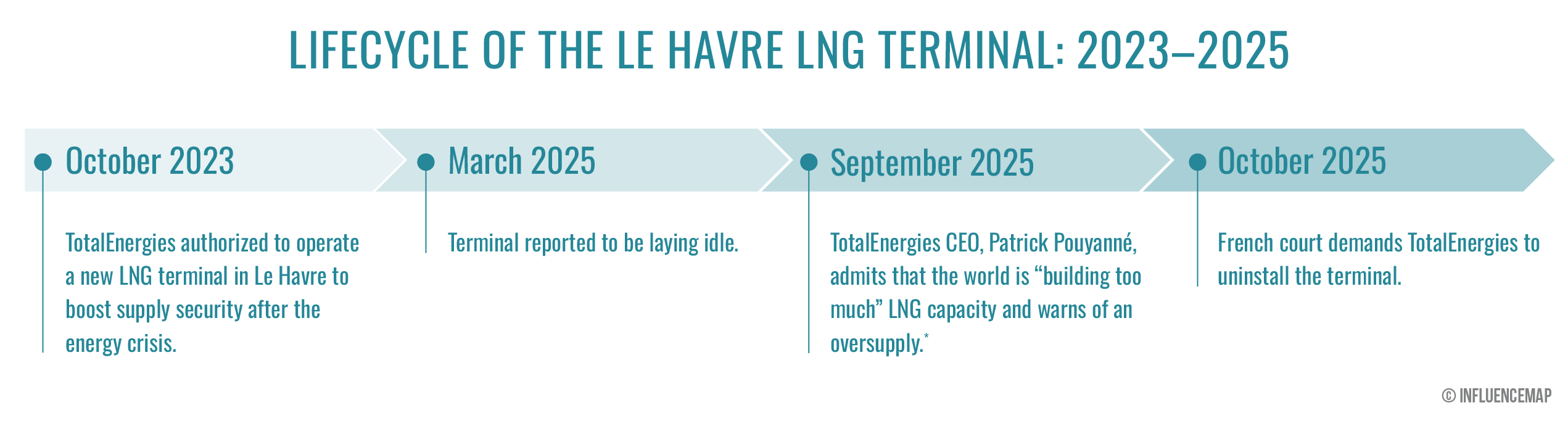
The Institute for Energy Economics and Financial Analysis (IEEFA) estimates that Europe’s regasification capacity will exceed actual LNG demand by more than three times by 2030, while the Commission indicates that, to meet its 2040 GHG emissions reduction target, gas demand for energy will decrease by more than 70% by 2040. This suggests new long-term fossil gas contracts or infrastructure risk undermining the EU’s climate targets while locking in significant stranded gas assets. For example, in October 2025, a French court ordered the French energy company TotalEnergies to uninstall the Le Havre LNG terminal, which lay inactive just two years after installation, ruling that the emergency situation that led to its installation no longer exists.
*“US Rush to Expand LNG Exports Heightens Fears of Global Gas Glut.” Financial Times, October 3, 2025.
Despite clear guidance that new fossil gas projects are incompatible with climate goals and that renewable development is key for securing Europe’s energy future, parts of the gas industry are actively promoting long-term fossil gas expansion as essential for energy security. If this messaging shapes the discussion around the revised Energy Security Framework, the resulting policy could lock in fossil fuel dependence and divert investment and attention away from renewables and electrification at a critical time. In advance of the December Energy Council meeting, it's critical that science-aligned industry voices calling for a rapid transition are heard. InfluenceMap will continue to monitor key developments concerning the EU Energy Security Framework on our website and via our weekly LobbyMap alerts email.
1 InfluenceMap uses science-based benchmarks derived from Intergovernmental Panel on Climate Change guidance on limiting global temperature rise to 1.5°C to assess whether a position is science-aligned or misaligned. For more information, visit the Science-Based Benchmark Database.